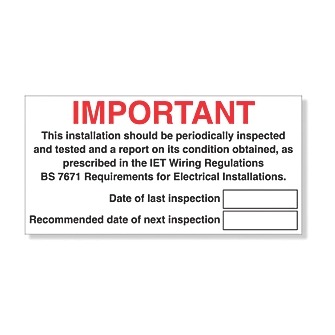
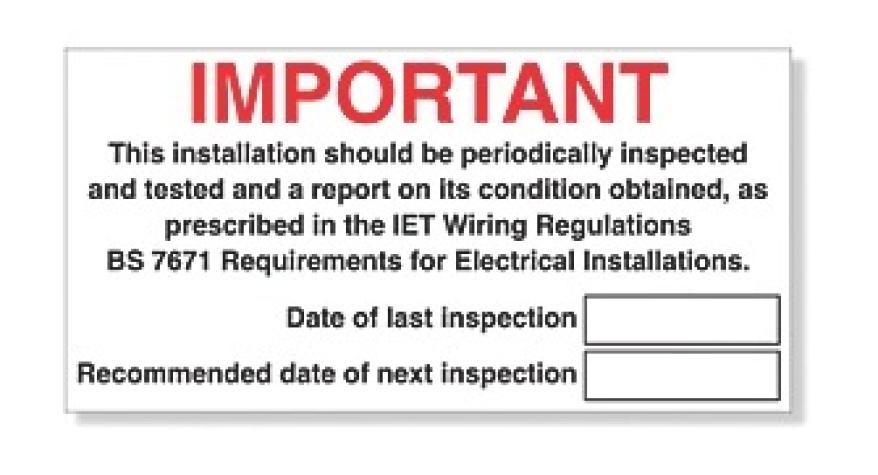
If you are a High Wycombe landlord and need to have a 5 yearly Electrical Installation Condition Report carried out. Be aware of some myths that some electricians will tell you about your electrical installation. Below are some examples:
A Consumer Unit Made From Combustible Material Needs Replacing
If a consumer unit is made from combustible material (e.g. plastic), the IET Best Practice Guide 4 (BPG4) recommends that the presence of a plastic consumer unit is worthy of a note, but does NOT warrant a classification code. If the consumer unit is located under a wooden staircase or within a sole route of escape from the premises, a C3 classification code is recommended.
Either way, this would not result in an unsatisfactory outcome.
A Bathroom Light Needs To Be Replaced As It Is Not IP65 Rated
The IET’s On-Site Guide is a good source of information, minimum IP rating for a luminaire installed in zone 1 of a room containing a bath or shower is IPX4, protection against splashing water.
The minimum IP rating for electrical equipment installed in zone 1 of a location containing a bath or shower is IPX4.
A Bathroom Fan Needs To Be 12V Extra Low- Voltage
Again, the IET’s On-Site Guide is an excellent source of information, Table 8.1 states that ventilation equipment installed in zone 1 of a bathroom is permitted to be 230 V, providing it is RCD protected and meets the minimum IP rating of IPX4.
230 V low voltage rated bathroom fans are permitted in zone 1 of the bathroom.
All Circuits Must Be RCD Protected
RCD protection is required for all socket outlets, a C3 classification code is recommended in BPG 4 where the socket-outlet is unlikely to be used for portable equipment outdoors.
A C3 classification code is recommended in BPG 4 for the absence of RCD protection for cables buried in walls at a depth of less than 50 mm, without mechanical protection.
BS 7671:2018 introduced requirements for additional protection for AC final circuits supplying luminaires within domestic (household) premises. If this is observed to be absent, BPG 4 recommends that a C3 classification code is attributed.
C3 classification codes do not result in an unsatisfactory outcome.
However, absence of RCD protection for a socket-outlet likely to be used for portable equipment for use outdoors or for circuits in a location containing a bath or shower would warrant a C2 classification code, which would result in an unsatisfactory outcome.
Rewireable Fuses Are No Longer Acceptable
Rewireable or semi-enclosed fuses to BS 3036 as they are referred to in BS 7671:2018+A1:2020, are indeed still permitted providing the appropriate correction factor (0.725) is used when determining the size of the conductor.
However, a ‘fuse box’ is unlikely to contain sufficient provisions for RCD protection where necessary and depending on the deficiencies observed, it may be more cost-effective to replace for a modern consumer unit.
The Installation Doesn't Contain a Fire Alarm or Emergency Lighting System
Inspection of fire alarm and emergency lighting systems do not generally form part of an EICR. However, power supplies and wiring of emergency lighting systems will be part of the fixed wiring installation and should be included.
Fire alarm and emergency lighting systems are required to be inspected in accordance with BS 5839 fire detection & alarm systems for buildings and BS 5266 Emergency lighting, code of practice for the emergency lighting of premises respectively.
Whilst deficiencies observed on fire alarm and emergency lighting systems during the inspection may be worthy of a general note, a classification code should not be attributed.
In Summary
An EICR is a factual report on the condition of an electrical installation and suitability for continued use.
The inspection and testing of an installation must only be carried out by (electrically) skilled persons with sufficient knowledge and understanding of electrical installations.
BPG 4 is an excellent guide to classification codes for common observations in domestic installations.
The EICR must be compiled in such a way that the person ordering the report can understand it. The condition of the installation should be accurately described to allow the person ordering the report to make an informed decision on the repairs to be carried out, based on the risk to the users of the installation.
At Plugs Electrical High Wycombe we carry out all EICR's to the IET's Best Practice Guide 4. If you'd like to discuss any of our services, get in touch today!